Cringe in the first degree
Oh! That's not-

My worst fear is that one day I will fall backwards down the stairs and break my neck. I live with this fear every day. It never leaves my peripheral vision. Every morning I have to consciously redirect myself away from thinking about the possibility as I tote my coffee back upstairs to do the crossword.
On bad days, when the moon is almost full, I can’t stop myself from imagining the scene vividly. Behind my eyelids, I see the coffee splattered on the steps and my twisted, contorted body splayed out on the ground.
When this happens, I cringe.
Biologically, my cringe is an involuntary response. Cringe is a survival instinct, an affective reflex reaction to something that signals danger. For obvious neck-related-primal-fear reasons, you can imagine how badly I cringe at episodes of Ridiculousness or the kind of YouTube videos men sometimes make you watch at the afters. Once, in Puerto Rico, I misjudged my grip strength and made a bad attempt at rope swinging into the water. I was fine, but all of my friends cringed. I cringe now just thinking about it, both the act itself and their responses, the same way I cringe thinking about every insensitive joke I’ve ever made or how I acted when I had shit boyfriends.
Of course, I also cringe when I see someone behaving embarrassingly on the Internet. Critically, this reaction serves the same purpose as the cringe I experience when imagining a backflip gone wrong. It’s a self-protective reflex hard-wired in my herd animal body, a culturally conditioned response to an obvious break from the social contract of “normal.”
What I’m interested in, to a truly obsessive degree, is how our increasingly cringe-fueled algorithms are preying on these involuntary responses and, I would venture, crafting a kind of collective, multi-generational inner narrative around the cost of trying anything risky at all.
To make my point I’ll need to give you a few examples. I do this knowing it means I am a horrible, no-good purveyor of gossip. I would say it brings me no pleasure, but then I would be lying — and as we’ll see, lying while also trying really hard is one of the worst things a woman can do.
The way I see it is, outside of actual documentations of physical harm, there are three main categories of cringe content online:
I. The Embarrassment
This is the average person who accidentally goes viral. Maybe they had a bad take — their Am I The Asshole post, which we should really be thanking them for as it’s one of the few not generated by bots, revealed them to be a total freak. Or perhaps they were too earnest, trying too hard, and what would’ve normally been a post stuck in the “100 views jail” broke containment and ended up on the “wrong side of the algorithm.” Maybe they’re someone with the “doesn’t get social cues” diagnosis behaving in a way that reveals (*gasp*) their lack of ability to grasp social cues. Or maybe, and this is increasingly the case, they were recorded without their knowledge acting in a way that other people find awkward, off-putting, or generally bad.
You can think here of the kid in that one video who kept saying “Nina,” or the “guy giving unsolicited advice to woman at the golf course” Reels I’m so often subjected to because I use the same WiFi network as my boyfriend.
This is my least favorite category of cringe, in part because there are no stakes. It’s all too familiar. Humans are social animals and sometimes when someone is speaking too loudly or being weird at a party we cringe — whoopdy doo, you know?
Still, these posts go viral. Cringe is a category of social media content, and like Ring camera outrage bait or montages of soldiers returning home from war it’s what the most annoying men on Earth might call a “growth hack.” There are Instagram pages dedicated solely to resharing videos of the viral cringe post of the day ad nauseam, racking up millions of views as a way of building ad space to promote fidget spinners or whatever pop girl of the month is being seed funded by Universal Music Group. And that’s not to mention the stitches and green screen reactions and YouTube creators who will recount the whole thing Thread for Thread within 24 hours.
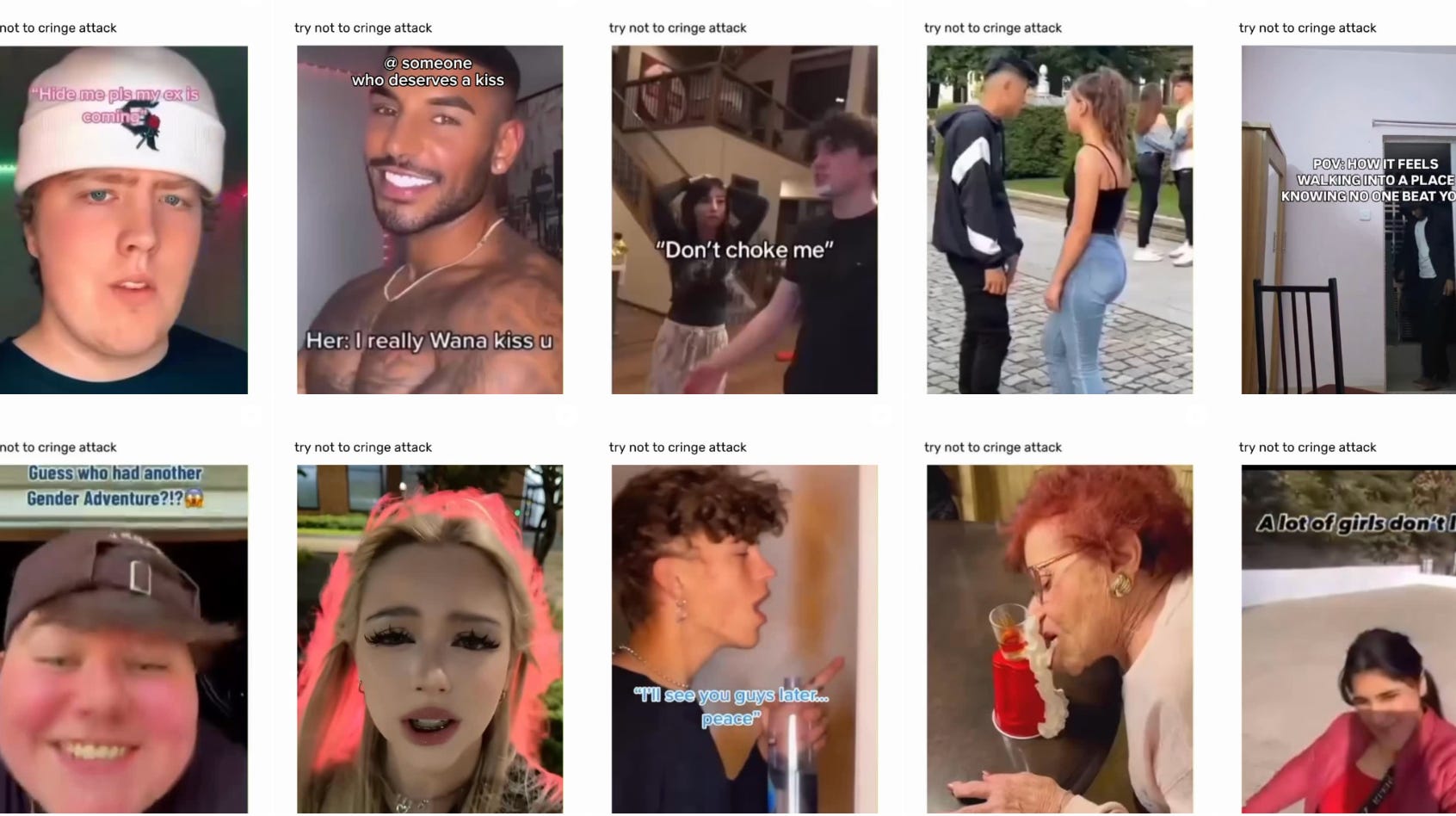
In any case, without the platform necessary to attract loyal haters or rare poeticism (“Just vote. I know I’m out, just vote.”) necessary to become a meme, these cringe posters and cameos tend to disappear into the endless scroll. A flash in the pan, really. Humiliating, but relatively easy to delete and/or move on from.
II. The Trainwreck
One level up from the embarrassment is someone I might lovingly call the trainwreck. This is not always a woman, but most of the time it is. The trainwreck needs to have at least somewhat of a degree of noteworthiness — maybe she has a mid sized following or runs a small business in town. This offers the hook.
Crucially, the trainwreck must be, for lack of a less egregiously co-opted phrase, actually crashing out on the Internet.
This is the domain of Love Island stars and wannabe Caroline Calloways, which is to say this is cringe content primarily trafficked through snark subreddits. But every in-group needs an out to define themselves by, and therefore you’ve likely seen the same behaviors play out across whatever subcultures and Internet corners you belong to.
Trainwreck cringe is simultaneously both the most fascinating and repulsive to me, which is to say it’s the genre I engage with the most. Cringe is, after all, a kind of trick mirror — there is no way to know a lot about, say, the girl who went online to post about her famous boyfriend being a dick but then forgot to delete the tracking parameters from the URL of the TikTok she linked and subsequently exposed herself in naked vulnerability to the cattiest women on the Internet without acknowledging how fundamentally embarrassing it is to be this fucking online.
Self-flagellation aside, what I find most engrossing about trainwreck cringe is our reaction to it. The behavior itself is whatever to me. Who among us hasn’t made a burner account to post long messages begging to be unblocked only to be notified seconds later that actually your phone number is linked and everyone you know just got a notification about it? Like, do you think you’re better than me?
I love the trainwreck because I’ve been her, and likewise I cringe at the trainwreck because I know how it feels to be that desperate to be understood. Most of the time I just feel like okay yeah, sometimes people have personality disorders.
Which is why it’s really the secondary sources, that Greek Chorus otherwise known as the comment section, that keep me glued to my phone when a trainwreck is afoot.
In general, I find a lot of snark coverage to be lacking, in part I assume because anyone who writes about it is inevitably exposing themselves to the snarkers for critique. I can feel myself now, mid-sentence, wanting to apologize in advance, to say “I come in peace” the way LA people do before they admit they don’t really listen to that much Taylor Swift.
But it’s only when a true trainwreck story is breaking — when the influencer calls off her engagement or her Instagram Story starts looking like a bunch of tiny ants — that I find the snarkers tend to actually reveal themselves.
Here are a few comments I archived during the aforementioned TikTok linkgate:
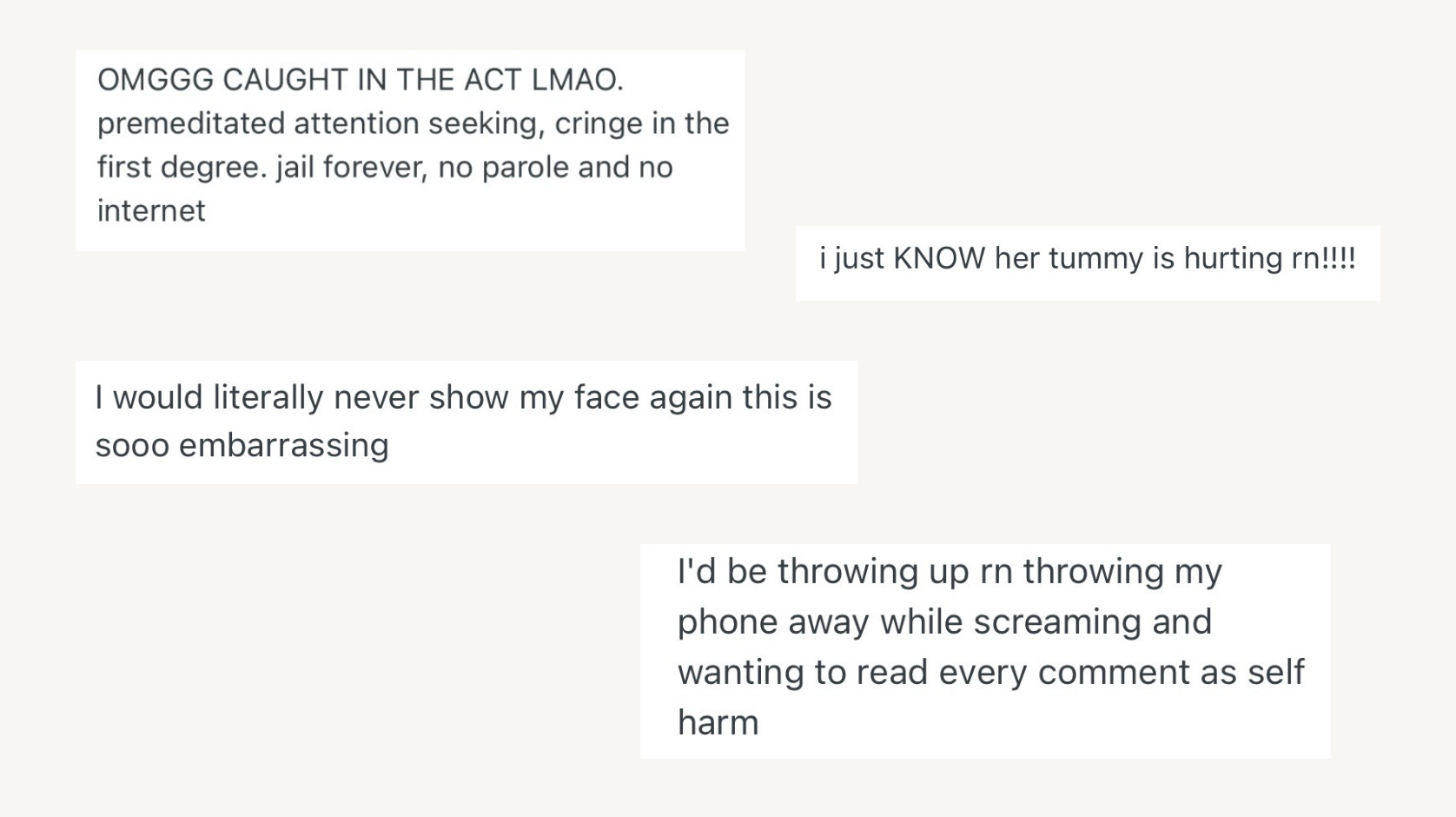
Those last two in particular are I think the most noteworthy, and perhaps the best example among the bunch of J. Logan Smilges’ cringe theory.
To borrow a quote: “Cringing occurs not necessarily when someone violates a social norm but when a person’s feelings toward such a violation fail to align with our own.”
Which is to say it’s not only the embarrassing act itself, but also the horrifying idea that the embarrassing person is not embarrassed enough — or better yet, not as embarrassed as we would be. If cringe is an involuntary response, a kind of psychosomatic tic, then it follows that in response we try and make meaning of it internally (“God, I would never”).
Which brings us to the third cringe archetype, the one I’m afraid to write:
III. The Problematic Person
I must make mention of one final category, that of the problematic person. I do so knowing there is no string of sentences I could ever write that would ensure I summarize this genre of cringe correctly, with enough nuance or “but actually ___ IS bad, to be clear!” to satisfy.
We must still talk about the problematic person, however, because we must be able to distinguish the sexual abuser being ousted from the scene from the person online who just kind of doesn’t have an instinct for good PR. As we’ll see, it is actually not that hard to become the problematic person, to the point where I kind of think becoming the problematic person is the inevitable end state of anyone who shares anything publicly on the Internet at all.
How many young adults alive right now were “cancelled” in a ~20 person Discord server at some point in their teens? How many people walking around us at any given moment have had a peak Tumblr era Google Doc callout made about them that essentially boiled down to a peer reviewed autism diagnosis? These are the things I think about when I’m stoned at the mall.
The problematic person style of cringe rarely gets identified as such, in part because it employs a powerful rhetorical tool: It feels justified. You’re probably imagining, right now, the countless takedowns you’ve witnessed (or participated in) and thinking, Well yeah, but that guy actually sucked and we had to get him out of here.
This sense of righteousness is essential to the problematic person genre of cringe. Like the embarrassment, who we cringe at hoping we’ll never become (again), or the trainwreck, who we cringe at because personally no offense we would just log off, our involuntary initial response to the problematic person is functionally self-protective in nature.
In stoning the scapegoat, we define ourselves and the “other.” What’s more, we call it healing. The longer we scroll, the more we read the comments and listen to the YouTubers who react to the comments and look through the Tumblr tags and follow the people who make a good point, the better we’re seemingly becoming — at least compared to them.
Cringing at the problematic person, then, is framed as act of self-improvement. There’s a reason we white women are — anecdotally! in my experience! THAT’S MY OPINION! — often the most annoyingly condescending online on the topic of social justice. When you feel like you have a lot to atone for, you’ll cling to anything that feels like penance. And it certainly doesn’t hurt that those “You shouldn’t be posting about your brunch right now and if you do you’re a Bad Person” posts tend to receive record levels engagement in the days immediately following a national tragedy.
The moral indignation is essential to the format. And yes, as my therapist reminds me often, not everything needs to be litigated into nuance. There are times where a visceral level of rage or disgust is warranted, and I too have learned a lot about my own values and morals through investigating my response to the discourse of the day.
But you’d perhaps be surprised how quickly being cringe or embarrassing can turn a person problematic in the eyes of their haters. If the cringe is the top of the funnel, the widest net of attention-generation, the problematization is the inevitable result of paying that much mind to what someone you really don’t like thinks, says, and does.
Ask the snarker why she’s still consuming so much content of her BEC (“bitch eating crackers”) and she’ll be quick to tell you about the time said BEC trivialized mental health or blocked her for “honest feedback.” In the absence of this kind of hard evidence, there’s also always the usual: She made this her job. She posted about her life. She went on that show. She chose this. Do you even know how much money she makes?
To be clear, I hold no pretense of being better than these commenters. This is, after all, my algorithm, too. Sometimes I attempt to convince myself that as a lurker I am, in fact, fundamentally different than the snarkers and pile-on-ers but unfortunately that’s not how the attention economy works — especially not now that I’ve written about it, exposing myself as cringe and tryhard and a person who knows better and still looks anyway.
I’m also not trying to lecture the snarkers. I’ve actually been in middle school before, thank you, and therefore I learned long ago what approaching the people whispering and saying “Please stop whispering” does to the level of whispering occurring in the room.
What I am interested in, however, is the question of what all this cringe content is doing to us.
We all know about the loneliness epidemic, the anxious generation, the generative AI stealing our jobs and likenesses and original thoughts and regurgitating them back to us optimized to elicit the biggest reaction possible.
One might wonder whether the anecdote to all of this shit is, I don’t know, singing your favorite song at karaoke or risking rejection in order to make new friends?
But how exactly can we do that if we’re constantly afraid of being cringy? Or better yet, afraid of being secretly recorded and turned into some incel freak’s LOLCow (sorry, I mean some very normal and well-adjusted woman’s BEC) online?
What I think might be happening, across multiple generations, is that in response to a surveillance culture and an attention economy that counts “people being weird and/or off-putting” as one of its primary drivers of engagement, we’re developing a sort of scar tissue over the muscles we need to be exercising the most — specifically the ones necessary in order to find a mate and get a decent job and, I don’t know, experience a sense of fulfillment.
You don’t have to be the person who badly attempted a backflip to see the clip on Tosh.0 and conclude you’ll never get on a trampoline again. I’ve never fallen backwards down the stairs and broken my neck — a fact that feels genuinely terrifying to admit because what if it happens tomorrow? (see also: “I’ve never been cancelled”) — and yet still I am deathly afraid of any hike that involves a scramble.
It’s only when I push through the fear, the anxiety, the well-meaning and just being realistic and “media-trained” inner voice telling me to stay back on safer ground that I actually accomplish anything satisfying at all.
When I attempted that rope swing in Puerto Rico, I was genuinely feeling excited and carefree. Even in the moments after I hit the water, I was thrilled — I knew it wasn’t graceful, but I had no truly idea that I’d actually done anything wrong.
It was only when I cleared the water from my eyes and looked into my friends’ faces that I noticed the rocks underfoot and fully grasped how bad it looked, how bad it could have been. Their cringe might’ve protected them, but in that moment it burdened me.
Later, when it came time to jump from the waterfall, I stood at the edge frozen with fear. The boldness and bravery I’d had access to mere hours before was gone — now, post-cringe, all I could imagine was how badly things could go.
It took me at least 10 minutes of standing up there, shivering, before I finally made the leap.
It’s true, I’m sure, that I could have died or been horrifically maimed in the process. But the thing I cringe at now is not the jump or potential for injury.
It’s the idea that I could’ve given up. The idea of shamefully climbing back down, disappointing my “No Fear” dad in heaven and betraying my own bravery in the process — that, more than the risk, is the thing I can no longer bear.