

Bored On The Internet?
Magnet poetry, three minute essays, and other ways to make Zooms more fun


When strangers ask me what I do for a living, I usually just say “marketing.” This is not a great elevator pitch but is much simpler than explaining that I run an Internet Café.
Realistically, if I were to create a shortlist of the jobs I have on any given Tuesday, I might include Teacher, Scribe, Facilitator, Zoom DJ, Strategist, Consultant, Host, Notion Designer, and perhaps even Professional People Person.
Needless to say, I’ve got a lot of thoughts about how to host meetings, and a lot more thoughts on how we might make the Internet a less boring place to work and live.
In this month’s edition of Observations & Inferences, I want to share with you a few very practical tips I’ve picked up from the last 5+ years of bringing people (usually from several different continents at once) into a Zoom room and then trying to make that feel like a real place.
In the experiment section below you’ll find a collection of my favorite virtual icebreakers, facilitation tools, and my personal best practices for hosting engaging events online.
In your corner,

P.S. This Thursday, I’m teaming up with Actually Curious and Daisy Made to host a workshop for facilitators. It’s called Gathering With Empathy, and I’d love to see you there — it will be a very fun chance to try out some new ways of bringing people together, and an opportunity to meet some new Internet Friends. Here’s a link for tickets. (Or enter a giveaway here!)


But first, the latest from members of The Study:
From Sara: Katja Markelova and I are hosting a “(C)osmosis” in Aswan, Egypt. This is going to be beautiful and I’m sure of it. Learn more here and/or fill out this form to register interest.
From Phoebe: A template for writing your next Artist Bio!
From Bonnie: I’m running a workshop on drafting a novel inside my Writing Club this Saturday at 11am-2pm EST!

In lieu of our usual structure, today I just want to offer you a good old fashioned collection of ideas to liven up your next virtual gathering:
1. Magnet Poetry (Icebreaker!)
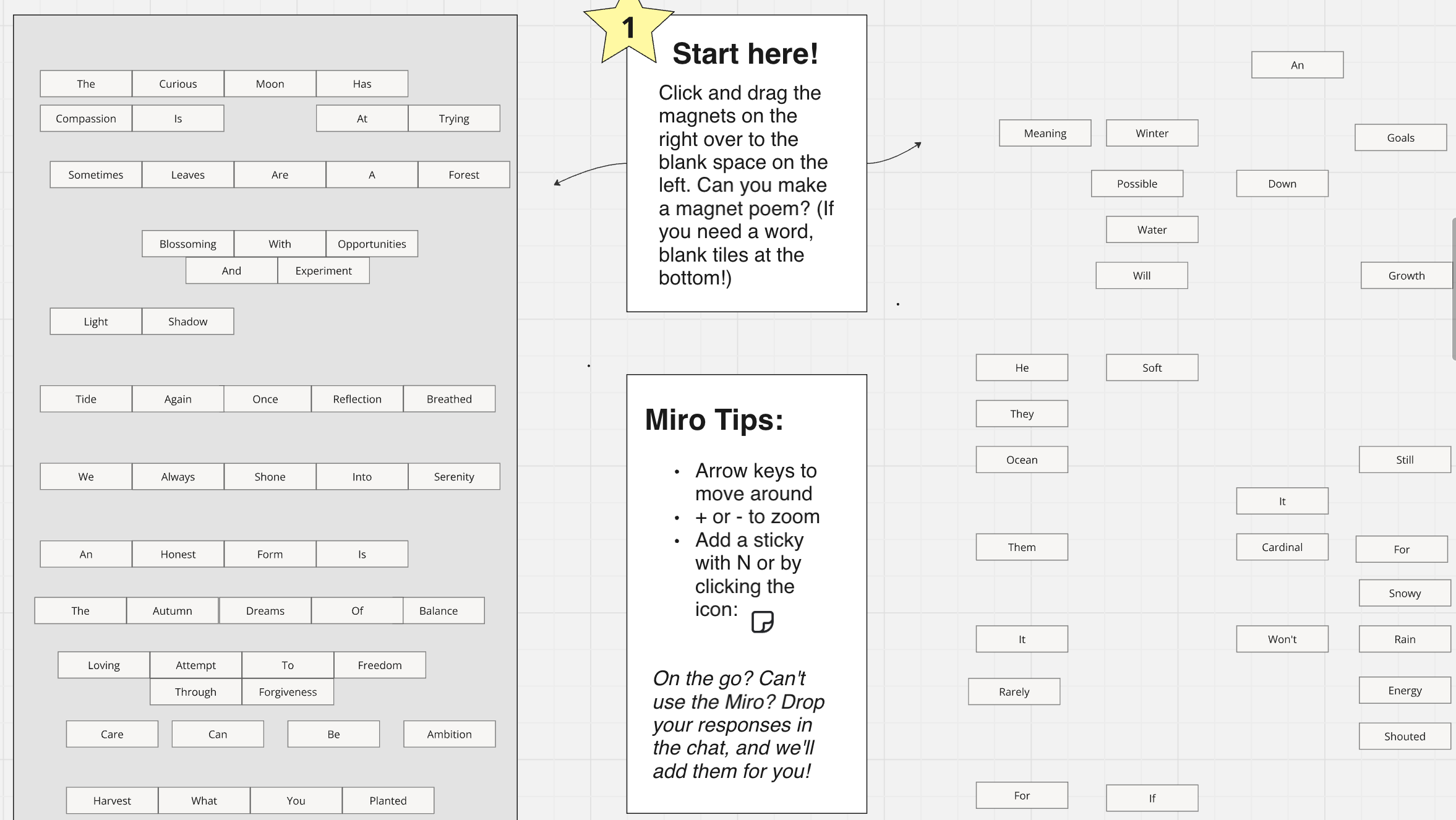
It always takes a few minutes for everyone to show up to a Zoom meeting, so I like to have something prepped for people to play with while they wait. One of my favorite activities is a take on magnet poetry, which I put together as a collection of individual elements on a Miro board. I drop the link in the chat, and ask people to rearrange the blocks to make their own poem.
2. Three Minute Essays
One piece of advice I got very early on was from Tara Mohr, who recommend trying not to talk in a virtual class for more than 10 minutes at a time—a great and practical tip but, as any teacher knows, one that can be challenging to stick to when no one feels comfortable coming off mute.
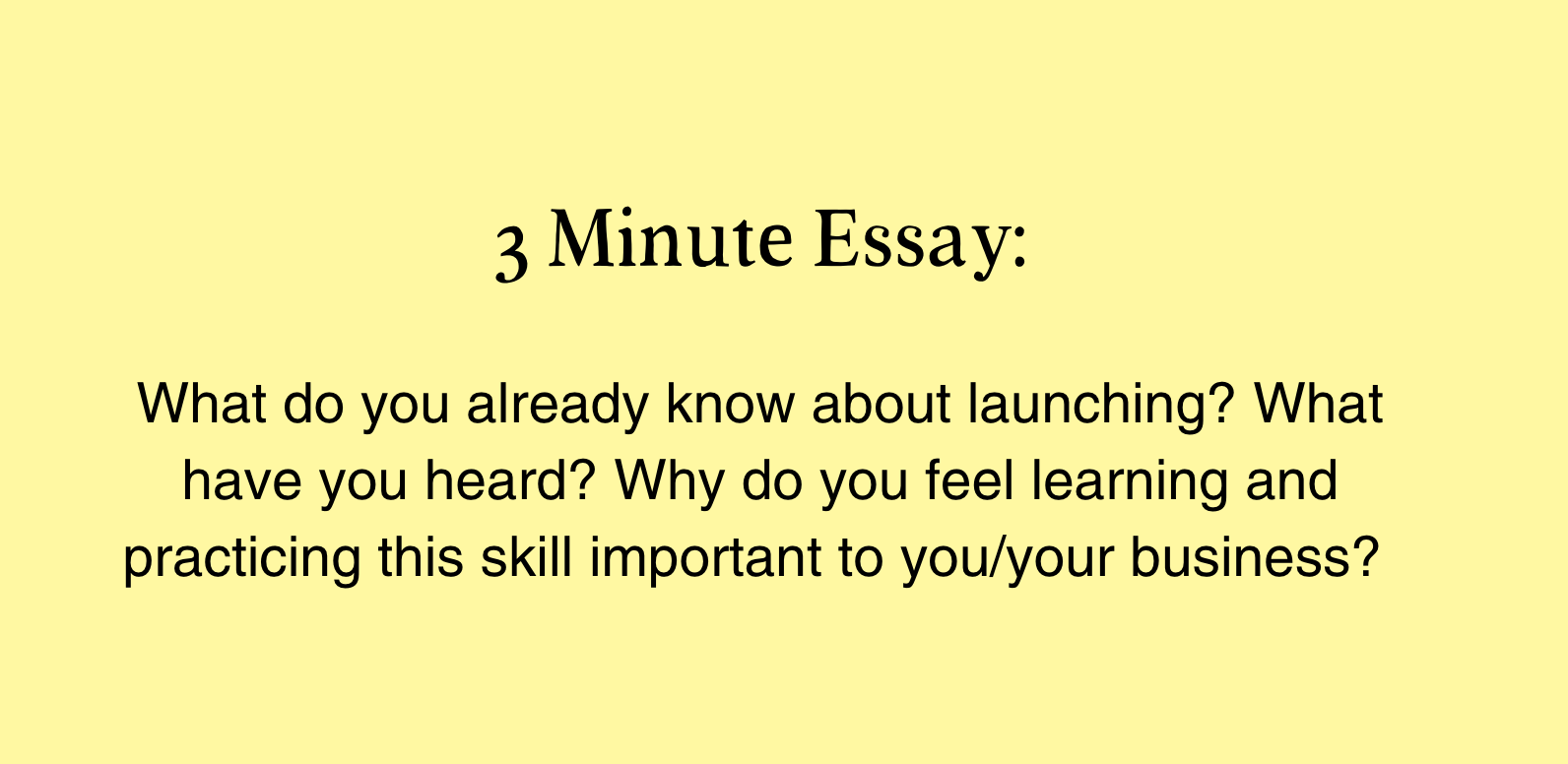
To help, I found an exercise in the book The Skillful Teacher called the Three Minute Essay. The idea is simple: Before you ask people to share their thoughts on a topic you’ve just lectured about, ask them to free-write for three minutes.
In practice, this helps take some of the pressure off of being “on the spot,” giving even the most introverted among us an opportunity to gather their thoughts and feel like they have something worth sharing with the group.
3. Digital Room Building
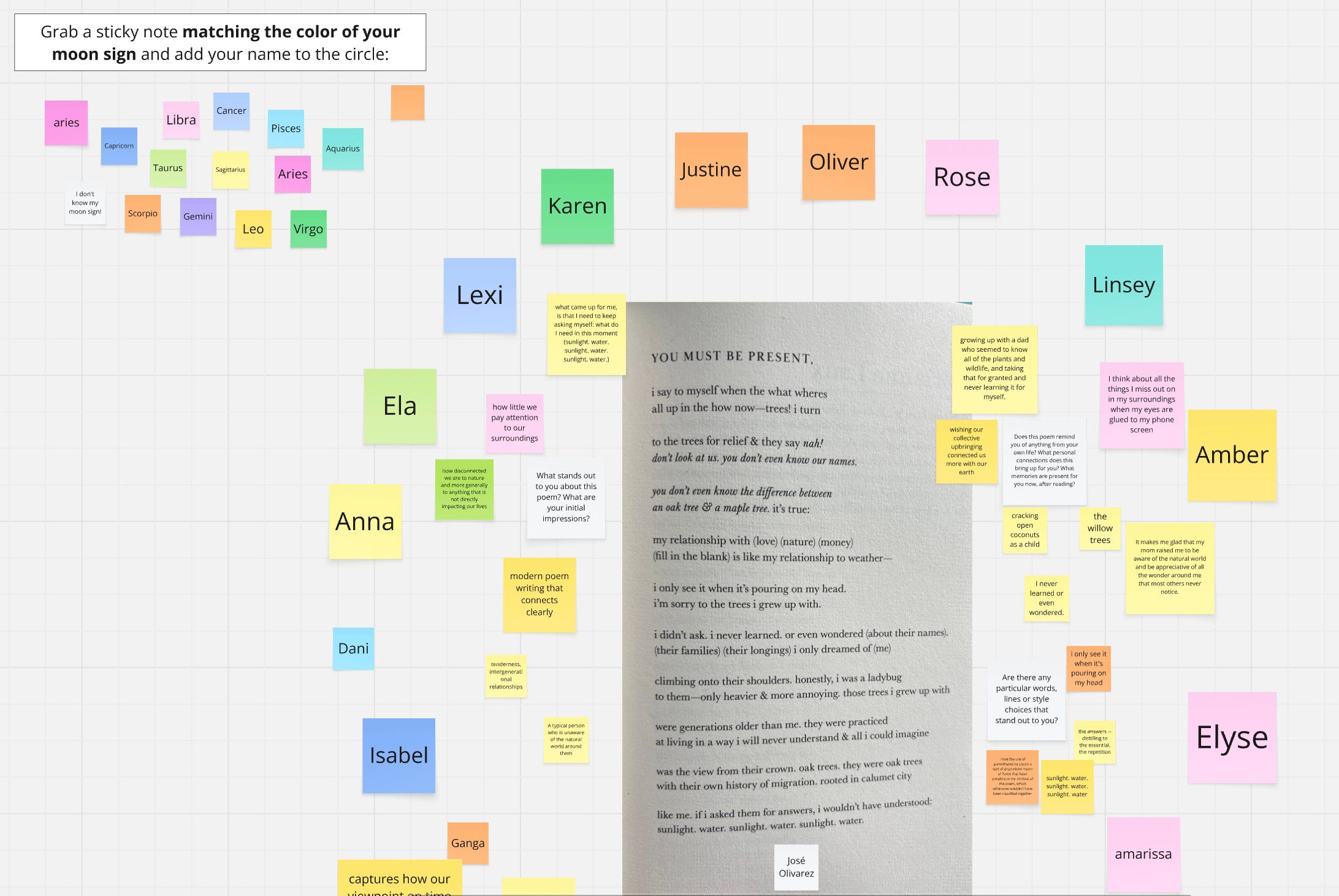
When I teach a free/live workshop, that can mean inviting anywhere from 30-100+ strangers into a Zoom room — this becomes a relatively easy thing to “check out” of. While I never demand complete attention or cameras on, I do like to try and create some sense of place, usually through a Miro board. Simply having attendees write their names on a sticky note and arrange them in a circle or at a few virtual “tables” can be enough to invite a more active participation.
4. Share The Mic
Back in 2020, when I opened the doors to The Study, I mistakenly thought I always had to be the sole expert in the room.
I quickly realized that I’d gotten extraordinarily lucky, and that the early adopters who joined in our prototype phase wanted to participate not just as question-askers but also as answer-offerers.
Five years and hundreds of Strategic Intuition Circles later, we’ve figured out together that what works for us is giving everyone a chance to share their perspective.
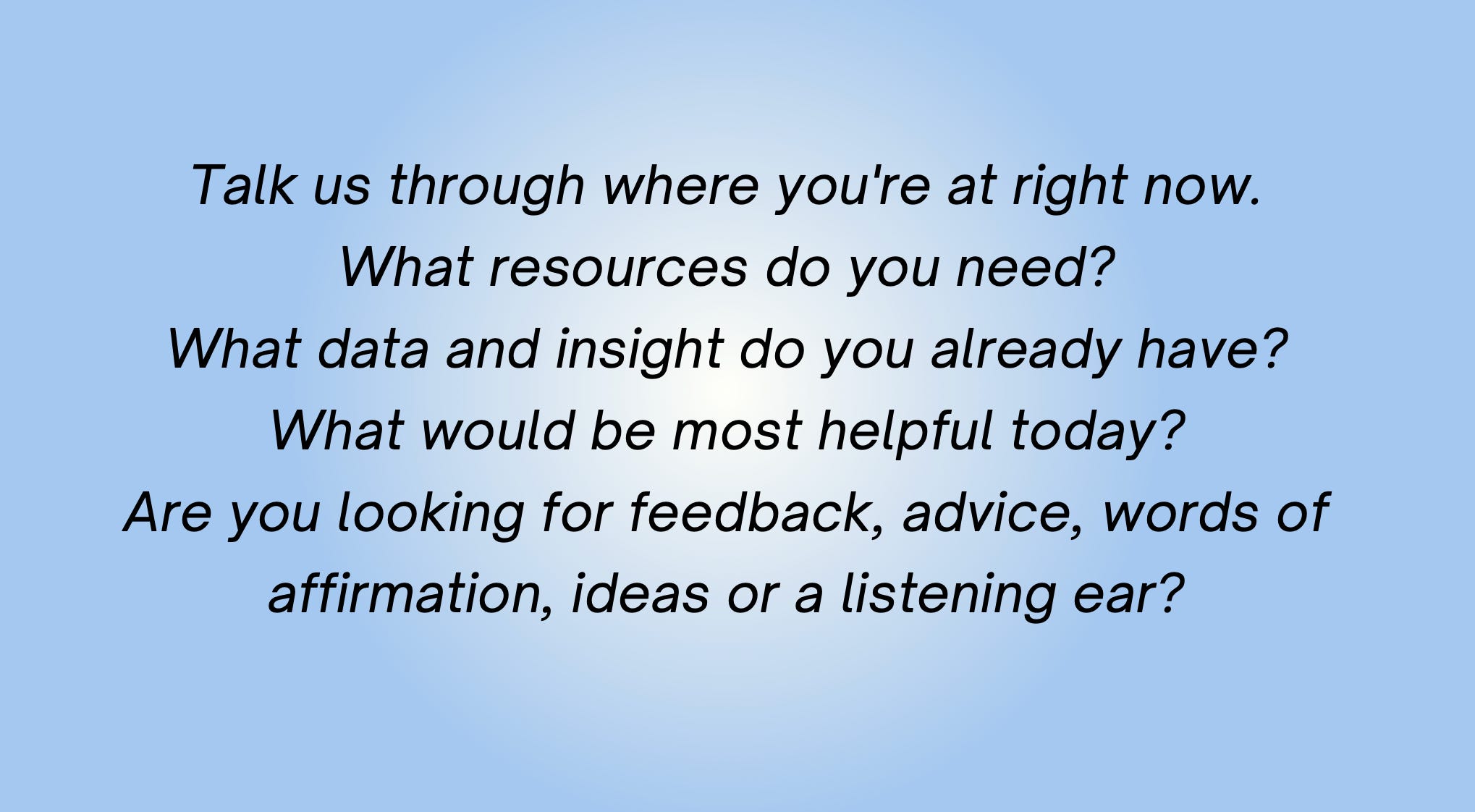
There’s just one rule: You have to say what you’re looking for.
Every creative type knows how it feels to be drowning in ideas and then have someone give you five more things you “should” try, so we just ask that anyone who brings us a strategic challenge tells us what they’re looking for: Feedback, advice, words of affirmation, ideas, or a listening ear.
5. Body Doubling
I’ll leave you with something I wish I’d known sooner: The reason I wasn’t finishing any of those courses I bought at 22 wasn’t that I was lazy or “uncoachable” (ew) but simply because they weren’t made for my brain. I wholeheartedly subscribe to the idea that designing for disabilities makes the world better for everyone, and part of that practice for me comes with adding in built-in time for body doubling.
If I teach a copywriting class, I’m going to build in real time to write some copy. If I host a life design workshop, I’m going to set a timer for 10 minutes and ask people to make the vision board or fill out the prompts while we’re all there together.
In other words, I try not to assign homework. I’d rather my workshops feel like an art class than a lecture.
Also, part of the problem of running your own business is you never make time to work on your own business, which is why I always dedicate space to actually do the thing you said you were going to do.
Observations & Inferences
It’s very hard to explain a thing that primarily exists online, which is why a few years back I asked people to explain my business in their own words.
To receive responses like “the place I go for answers for the weird little problems keeping me up at night,” or “a non-judgmental place where you can talk about business and be met with kindness and support” is, for me as an artist, the definition of fulfilling.
I don’t know if I’d get answers like that if The Study (or the Pretty Decent Internet Café as a whole) was just a place to watch pre-recorded lectures of me explaining marketing strategies. I think most of what makes it “work” is the fact that people actually leave with a sense of common humanity—that idea that no matter how complicated or confusing things get, we’re never the only one.
Maybe magnet poetry and three minute essays are the secret, or maybe I’ve just gotten very lucky. Probably a little of both.
Either way, I’m grateful that my weird little job exists, in large part because one day five years ago I decided to make it up. <3
Love this! Any chance the recording or a summary of the faciltators meeting will be available? I read this post too late :(
This is so helpful, thanks so much Lexi!